

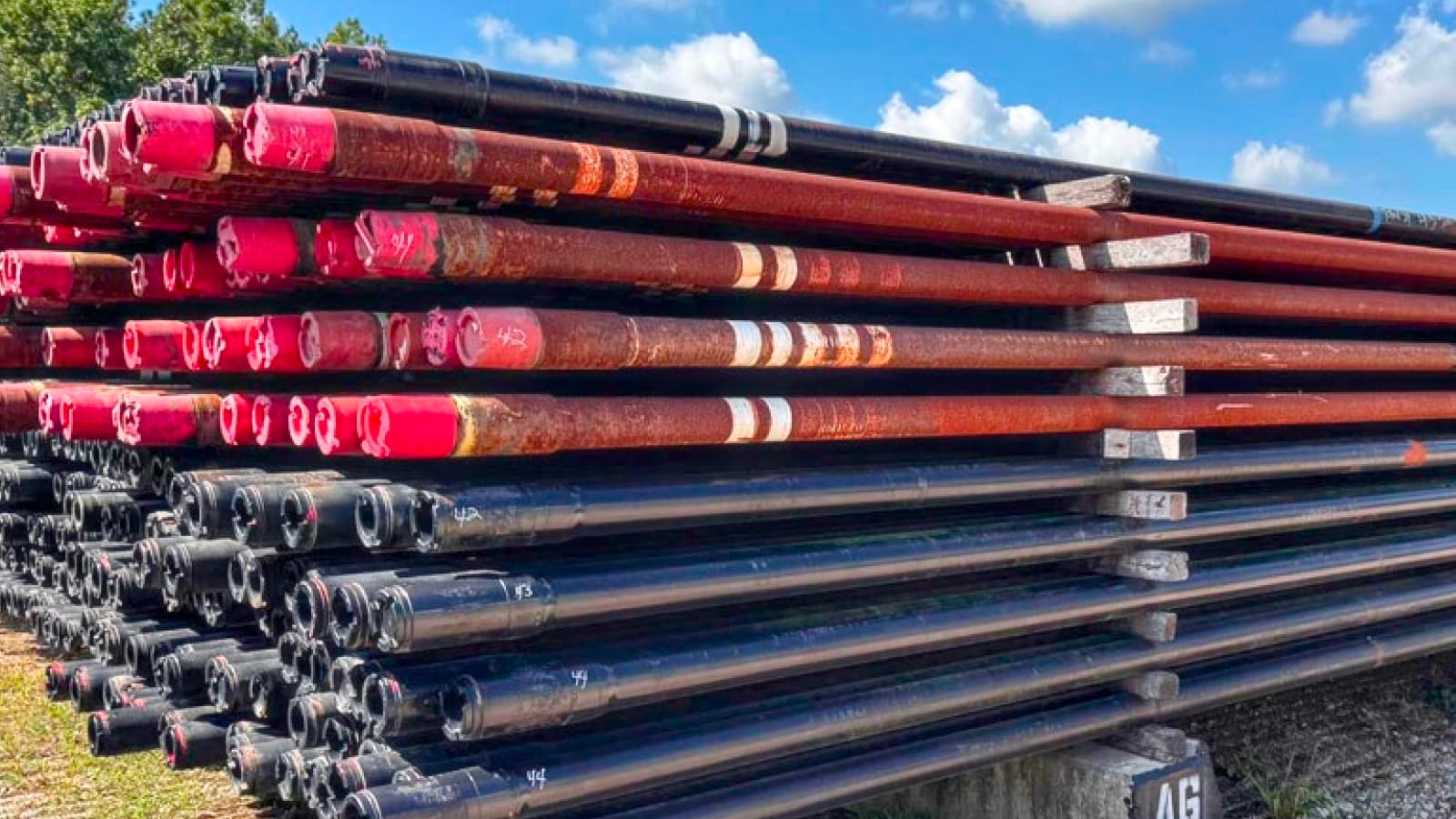
The Complete Guide to Drill Pipe Grades
Drill pipe is one of the most commonly listed items on this marketplace, and one of the most commonly misunderstood. Two joints that look identical in a photo can have wildly different value depending on their steel grade, inspection class, and connection type. This guide breaks down what actually determines a joint of drill pipe's strength, suitability, and price — whether you're buying, selling, or just trying to read a listing accurately.
Why grade matters more than it looks like it should
Drill pipe grade refers to the steel's yield strength — the point at which it stops behaving elastically and starts to permanently deform. A higher grade doesn't mean "better" in every situation; it means the pipe can handle more torque, tension, and pressure before it's at risk. Using the wrong grade for the wrong well isn't just inefficient, it's a safety and liability issue. Getting grade right is the first filter any serious buyer applies before looking at anything else on a listing.
The API grade system
The American Petroleum Institute (API) standardizes drill pipe into a small number of grades, each identified by a letter/number combination that indicates minimum yield strength in thousands of pounds per square inch (ksi):
E-75 — 75,000 psi minimum yield. The baseline grade, still common in shallower, lower-torque applications where cost matters more than margin for error.
X-95 — 95,000 psi. A step up in strength, often used as a middle-ground option between E-75 and the higher grades.
G-105 — 105,000 psi. One of the most widely used grades in modern drilling, especially in longer laterals and moderate-depth wells common across the Permian Basin.
S-135 — 135,000 psi. The highest standard API grade, used in deep, high-torque, extended-reach applications where the pipe needs maximum strength margin. Beyond these, some manufacturers produce proprietary ultra-high-strength grades (sometimes labeled Z-140, V-150, or similar) for extreme-depth or high-torque unconventional wells. These aren't API-standardized, so if you see one of these grades on a listing, confirm the manufacturer's own certification documentation rather than assuming it maps directly onto the API scale.
Grade is only half the picture — inspection class matters just as much
Two joints of S-135 pipe can be worth very different amounts depending on their inspection class, which reflects wall thickness remaining after wear, not the original manufactured strength:
Premium Class — Pipe with minimal wear, closest to new condition. Commands the highest resale value within its grade.
Class 2 — Moderate wear, still fully serviceable for most standard applications, priced accordingly below Premium.
Class 3 — Significant wear. Often restricted to lower-stress or shallower applications, priced well below Premium and Class 2.
Reject — Pipe that no longer meets minimum wall thickness or other safety thresholds. Not usable for drilling; typically only has scrap value. A listing that states grade but omits inspection class is missing the single most important pricing variable after grade itself. If you're buying, always ask for recent inspection documentation (ultrasonic wall-thickness testing, drift testing, and a visual/magnetic particle inspection report) rather than relying on a seller's verbal description of "good condition."
Tool joints and connections
The tool joint — the threaded end that connects one joint of pipe to the next — is a separate wear item from the pipe body itself, and it's graded and inspected independently. Common connection types include NC38, NC46, NC50, and various proprietary high-torque connections used in extended-reach drilling. A pipe body in excellent condition with a badly worn or re-cut tool joint is a very different (and less valuable) purchase than one with both in matching condition. When evaluating a used string, check whether tool joints have been re-cut or hardbanded, since this affects both remaining life and compatibility with your existing string.
Matching grade to the well
As a rough framework, grade selection depends on:
Depth — deeper wells create more hanging weight (tension) on the pipe string, which pushes toward higher grades.
Torque and drag — longer laterals and directional/horizontal sections increase torque loading, which is where G-105 and S-135 earn their keep over E-75.
Mud weight and pressure — higher-pressure applications add additional stress considerations beyond simple tension and torque. Buying pipe rated well above what your application actually requires isn't wrong, but it does mean paying a premium for margin you may not need. Buying pipe rated below your application's real demands is the mistake that actually costs money and creates risk later.
What to check before buying used drill pipe
Confirm grade markings — Grade should be stamped on the tool joint. If markings are worn or illegible, request mill certification or third-party inspection documentation instead of taking a seller's word for it.
Ask for recent inspection reports — Ultrasonic wall-thickness testing and drift testing should be recent, not from years prior, especially if the pipe has been in active service since.
Inspect tool joint condition — Look for re-cutting history, thread wear, and hardbanding condition.
Check for consistent lot history — A full string from one well/operator with consistent maintenance records is generally a safer buy than a mixed lot assembled from multiple sources.
Verify quantity and length consistency — Range 2 (typically ~31 ft joints) is standard for most land rigs; confirm the listing's stated range matches what's actually being offered. ## Buying and selling drill pipe on Black Diamond
When listing drill pipe on this platform, include grade, inspection class, connection type, range, and total footage or joint count at minimum — these are the details serious buyers filter on first, and complete listings clear faster. If you're evaluating a listing that's missing this information, it's worth reaching out directly before assuming anything about condition or value based on photos alone.